- 79 Station Ln, Hornchurch, RM12 6JU
- 01708 607930
- info@charismabeautylounge.co.uk


Stepping into the world of Botox in Hornchurch for the first time is a big moment, but it’s also one of the simplest and safest cosmetic decisions you can make. Most first-time patients are everyday people in their late 20s to 40s who want to soften early lines or stop deeper ones from forming. When performed by a trained, qualified professional, Botox has an exceptional safety record and delivers predictable, subtle results. This complete guide is designed specifically for beginners and answers every question you probably have right now.
You’ll still look like you, only more rested, brighter, and less tired or serious when your face is relaxed. The majority of first-timers say the experience was far easier and quicker than they imagined.
Botox is a purified protein called onabotulinumtoxinA that temporarily relaxes specific facial muscles. It works by blocking the nerve signal that tells a muscle to contract, so the muscle stays calm and the skin above it stays smooth.
It only treats dynamic wrinkles, the lines that appear when you make expressions. Forehead lines when you raise your brows, the vertical “11s” when you frown, and crow’s feet when you smile are the classic examples. Lines that are visible even when your face is completely still are usually better treated with fillers or skin resurfacing. For those curious about how long Botox lasts, understanding its duration and factors that affect results can help plan future treatments.
Common areas beginners choose:
Horizontal forehead lines
Glabellar lines (between the eyebrows)
Crow’s feet (outer corners of the eyes)
Sometimes, a gentle eyebrow lift or reduction of “bunny lines” on the nose
The standard goal for a first appointment is a natural, refreshed appearance where you can still move your face and show emotion.
Almost every healthy adult is a potential candidate. The most common age to start is 25–45, but people begin in their early 20s or wait until their 50s and still see excellent results.
Men respond just as well as women and now make up a growing percentage of first-time patients. Male muscles are typically stronger, so slightly higher doses are used, but the outcome is equally natural.
Botox is not suitable if you have:
Active neurological diseases such as myasthenia gravis, ALS, or Lambert-Eaton syndrome
Known allergy to botulinum toxin or human albumin
Infection or open wound at the planned injection sites
Pregnancy or breastfeeding (no safety data exists)
Recent facial surgery within the last six months
If you take daily aspirin, warfarin, or other blood thinners for medical reasons, treatment is still possible, but bruising risk increases. For a more detailed overview of treatment options and safety, check out our Botox anti-wrinkle injections guide.
Your first appointment is a conversation, not a procedure. Expect to spend 20–40 minutes with the practitioner. They will watch your face in motion, asking you to raise your eyebrows, frown deeply, squint, and smile widely to map exactly which muscles are overactive.
You’ll talk openly about what bothers you and how subtle or noticeable you want the change to be. Some patients hate looking angry at rest; others wish to soften forehead lines. Honesty here gives the best outcome.
The practitioner will explain:
You’ll leave the consultation knowing exactly what will happen next time and whether Botox is right for you.
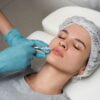
The actual treatment day is quick and straightforward. You sit or semi-recline in a clean medical chair. The skin is cleansed with alcohol or antiseptic wipes.
Many clinics offer optional numbing cream applied 15–20 minutes beforehand, though most first-timers skip it because the needles are extremely fine (30–32 gauge, thinner than a hair).
The injector uses a tiny insulin-style syringe. Each poke feels like a quick pinch or mosquito bite, lasting less than a second. Most patients describe the sensation as surprisingly mild.
Step-by-step process:
The entire appointment from walking in to walking out is typically 15–25 minutes.
You can resume normal activities right away, including driving and returning to work. Makeup can be applied immediately if desired.
For the first 4 hours:
For the first 24 hours:
Many practitioners recommend gently exercising the treated muscles (frowning, raising brows, smiling) every 10–15 minutes for the first hour to help the product settle evenly.
First-time patients usually see the effect begin around day 3–5, with full smoothing by day 10–14. Results typically last 3–4 months for beginners.
Factors that affect duration:
Many people find that after 2–3 consistent treatments scheduled every 3–5 months, the effects start lasting 4–6 months because the muscles become trained to stay relaxed.
A complimentary adjustment appointment at the two-week mark is common for first-timers if any area needs a tiny touch-up.
“Will my face look frozen?” When dosed conservatively, you keep natural movement. Skilled injectors never aim for zero expression unless specifically requested.
“Does it really hurt?” Most patients rate discomfort 1–3 out of 10. The forehead and crow’s feet areas are usually the easiest; the area between the brows can feel a sharper pinch for a second.
“What if I don’t like the results?” Effects are temporary and always wear off completely. If something feels too strong, it can sometimes be softened with additional tiny injections in opposing muscles.
“Is Botox actually safe?” Cosmetic doses are thousands of times smaller than any amount that could cause harm. Serious complications are extraordinarily rare when performed by trained medical professionals.
To reduce bruising and swelling:
Consider taking arnica tablets or eating fresh pineapple a few days before both may help minimise bruising.
Schedule your appointment at least two to three weeks before any big event (wedding, photoshoot) to allow full settling and any minor adjustments.
Normal:
Occasional but still common:
Rare but possible:
Contact your practitioner immediately if you experience severe headache, vision changes, difficulty swallowing, or widespread muscle weakness (these are extraordinarily rare with cosmetic dosing).
Experience dramatically affects outcome and safety. Look for:
Red flags to avoid:
A trustworthy practitioner will sometimes recommend less treatment or an alternative if Botox isn’t ideal for your concern.
Your first Botox appointment is quick, low-risk, and far less dramatic than you might imagine. The vast majority of first-timers leave thinking, “That was it? I should have done this sooner.”
Natural, subtle results are not only possible, but they’re also the standard when you choose an experienced, qualified professional who listens to your goals. You deserve to look as refreshed on the outside as you feel on the inside.
Take the next step with confidence. Book a no-pressure consultation, ask every question on your mind, and discover how easy it is to love the skin you’re in at every age.
Recent Posts




WhatsApp us